"The majority of Christian ministers serve in secular jobs, where they daily have the opportunity to fulfill Christ's command. They may be doctors, nurses, bank clerks, factory workers, schoolteachers, homemakers, students or bus drivers. While the work they perform does not always seem directly related to ministry, the context provides an opportunity to serve people as they serve the Lord."
-- from "The Transforming Path"
Tuesday, August 04, 2015
Friday, July 17, 2015
Terry Wardle on Compassion
"How can a Christian turn a blind eye to a hurting world? To do so they must choose a path other than the one Jesus took in life. It is the only way. Jesus became human in order to better identify with the human experience. He walked with the broken, listened to their stories, saw them struggle in life, and heard the cry of their tender hearts."
-- from "The Transforming Path"
-- from "The Transforming Path"
Tuesday, June 30, 2015
Book Review
This review originally appeared on the Alan's Eyes & Ears blog:
Saints Behaving Badly, by Thomas J. Craughwell. Hardcover.
Saints Behaving Badly, by Thomas J. Craughwell. Hardcover.
The cover promises to tell the stories of “cutthroats,
crooks, trollops, con men and devil worshippers who became saints.”
I knew the stories of many of these saints, including Augustine, Patrick, and Ignatius. But there were many more obscure saints and stories that I did not know. The story of St. Moses the Ethiopian, a violent gang leader in the 300s who later embraced the life of fasting and prayer after seeking shelter with a community of monks, was unknown to me. Also the biography of St. Alipius, a student of the Augustine (another infamous and notorious sinner turned saint), was "obsessed with blood sports" and all types of gambling.
Balancing the humor inherent in some of these stories with the proper tone of reverence is not easy. But Craughwell does manage to accomplish this, with each of these small (4 to 10 pages) vignettes demonstrating his basic point that a saint is made and not born, and that nobody is beyond the reach of the grace of God.
Craughwell set out to present a readable, entertaining, and inspiring book of saint stories. And with those as his marching orders, I’d say he succeeded.
Source: public library
I knew the stories of many of these saints, including Augustine, Patrick, and Ignatius. But there were many more obscure saints and stories that I did not know. The story of St. Moses the Ethiopian, a violent gang leader in the 300s who later embraced the life of fasting and prayer after seeking shelter with a community of monks, was unknown to me. Also the biography of St. Alipius, a student of the Augustine (another infamous and notorious sinner turned saint), was "obsessed with blood sports" and all types of gambling.
Balancing the humor inherent in some of these stories with the proper tone of reverence is not easy. But Craughwell does manage to accomplish this, with each of these small (4 to 10 pages) vignettes demonstrating his basic point that a saint is made and not born, and that nobody is beyond the reach of the grace of God.
Craughwell set out to present a readable, entertaining, and inspiring book of saint stories. And with those as his marching orders, I’d say he succeeded.
Source: public library
Friday, June 12, 2015
Bruce Cockburn on How We Live
" ... no matter what, as we live and we die, we are always moving toward a sort of mutual absorption of and by spirit; that my soul remains rooted in the Divine; and that life is, or ought to be, ruled by love."
-- From "Rumours of Glory: a memoir"
-- From "Rumours of Glory: a memoir"
Wednesday, May 27, 2015
Bruce Cockburn on The Mysticism of Marriage
"The church where Kitty and I were married was a human construct built to accommodate and celebrate the possibility of a relationship with God. But I don't think it was about the building. It is the opening, the baring of souls to each other and therefore to the Divine, that allows these communications to occur. I will say, though,that we seemed to be i the right place at the right time, doing right by God in his house, and that might have helped."
-- From "Rumours of Glory: a memoir"
-- From "Rumours of Glory: a memoir"
Monday, May 11, 2015
Bruce Cockburn on Discovering the Mystics
"I discovered Tielhard de Chardin, the Jesuit priest/paleontologist whose writings defied Church doctrine, and behind him I found a trail of Christian mysticism I had not known existed, a strain so powerful that it had been strategically sidelined by mainstream church leaders whose temporal power was anchored in mythic history and rule-maikng"
-- from "Rumours of Glory: a memoir"
-- from "Rumours of Glory: a memoir"
Monday, April 20, 2015
Book Review
This review originally appeared at Alan's Eyes & Ears:
Little Black Sheep: A Memoir, by Ashley Cleveland. NOOK.
I have known of Ashley Cleveland since her debut album Big Town came out in 1991, and have had positive feelings about her and her music since. She was on the fringes of the Christian music scene in the nineties, and I was a fan of a lot of artists who were on the fringes of the Christian music scene in the nineties.
I lost track of the specific of her career over the years, other than the vague notion that she put out a critically-acclaimed album a few years ago. That album, Before the Daylight's Shot, in fact won a Grammy Award in 2008 for Best Rock Gospel Album.
But I knew nothing about her life. This book fills in all of the gaps. Raw and vulnerable, Cleveland details her troubled upbringing with disconnected parents, and her own struggles and addictions. Even as she was winning Grammy winner in the Gospel music world, she was an alcoholic and addict.
The nice thing about memours by songwriters, is that they tend to be very good writers, and Cleveland's skill with words and images are obvious in the writing. She has come to a nice place in her life and her career as she approaches 50, and she hopes all her worst days are behind her. But as she details in the book, every day has its own struggles, and its own little victories.
Source: A group on Facebook posted that this book was free for a few days through the Nook store, and I grabbed it during that window of opportunity.
Little Black Sheep: A Memoir, by Ashley Cleveland. NOOK.
I have known of Ashley Cleveland since her debut album Big Town came out in 1991, and have had positive feelings about her and her music since. She was on the fringes of the Christian music scene in the nineties, and I was a fan of a lot of artists who were on the fringes of the Christian music scene in the nineties.
I lost track of the specific of her career over the years, other than the vague notion that she put out a critically-acclaimed album a few years ago. That album, Before the Daylight's Shot, in fact won a Grammy Award in 2008 for Best Rock Gospel Album.
But I knew nothing about her life. This book fills in all of the gaps. Raw and vulnerable, Cleveland details her troubled upbringing with disconnected parents, and her own struggles and addictions. Even as she was winning Grammy winner in the Gospel music world, she was an alcoholic and addict.
The nice thing about memours by songwriters, is that they tend to be very good writers, and Cleveland's skill with words and images are obvious in the writing. She has come to a nice place in her life and her career as she approaches 50, and she hopes all her worst days are behind her. But as she details in the book, every day has its own struggles, and its own little victories.
Source: A group on Facebook posted that this book was free for a few days through the Nook store, and I grabbed it during that window of opportunity.
Friday, March 27, 2015
N.T. Wright on Jesus' Empire
"Instead of the eagle with its talons and claws, Jesus summoned people to a different kind of empire: peacemaking, mercy,humility and a passion for genuine and restorative justice."
-- from "Paul and the Faithfulness of God"
-- from "Paul and the Faithfulness of God"
Monday, March 09, 2015
John Paul II on Invitation
"We are all invited to participate in this process of leaving behind the well-known, the familiar. We are all invited to turn toward the God who, in Jesus Christ, opened Himself to us, "breaking down the dividing wall of enmity" (Eph. 2:14) in order to draw us to Himself through the Cross."
-- from "Rise, Let Us Be On Our Way"
-- from "Rise, Let Us Be On Our Way"
Sunday, February 08, 2015
NT Wright on Evil
"Monotheism of any kind always faces a challenge in dealing with the fact of evil; particularly human evil, but also the sense that the whole creation is somehow infected with a sickness that thwarts the creator's purpose, which is that his glory and power should fill the whole world." -- from "Paul and the Faithfulness of God"
Thursday, January 22, 2015
Book Review
This review originally appeared on the Alan's Eyes & Ears blog:
The Ecclesiastical History of the English People, by The Venerable Bede. Unabridged audio.
I am a sucker for church history, but it took me a while to get around to reading the most famous piece of church history from the first millennium.
The focus is on the Christian history of the British Isles. This has been a particular interest to me since I ran across the music of the UK-based band Iona more than 20 years ago. Bede hits the main characters and locals that I was hoping for, such as Iona, Lindisfarne, Columba, and Columcille.
There are certainly moments of dryness in the accounts, as many of the people and circumstances have been lost to time (save this book). But many of the accounts were colorful, and so although some of the chronologies did not stick with me, many of the stories did. The relationships between the various British peoples, both with each other and with the authorities in Rome, form a backbone for the history.
In terms of theology, the issue that Bede spends the most time on is the correct dating for Easter. Although backing the Roman interpretation, he is gracious to other believers who believe differently.
The Ecclesiastical History of the English People, by The Venerable Bede. Unabridged audio.
I am a sucker for church history, but it took me a while to get around to reading the most famous piece of church history from the first millennium.
The focus is on the Christian history of the British Isles. This has been a particular interest to me since I ran across the music of the UK-based band Iona more than 20 years ago. Bede hits the main characters and locals that I was hoping for, such as Iona, Lindisfarne, Columba, and Columcille.
There are certainly moments of dryness in the accounts, as many of the people and circumstances have been lost to time (save this book). But many of the accounts were colorful, and so although some of the chronologies did not stick with me, many of the stories did. The relationships between the various British peoples, both with each other and with the authorities in Rome, form a backbone for the history.
In terms of theology, the issue that Bede spends the most time on is the correct dating for Easter. Although backing the Roman interpretation, he is gracious to other believers who believe differently.

Saturday, January 03, 2015
John Paul II on Faith
"Beginning with Abraham, the faith of each of his sons represents a constant leaving behind of what is cherished, familiar, and personal, in order to open up to the unknown, trusting in the truth we share and the common future we all have in God."
-- from "Rise, Let Us Be On Our Way"
-- from "Rise, Let Us Be On Our Way"
Thursday, December 11, 2014
John Paul II on Trials
"We will certainly encounter trials. There is nothing extraordinary about this, it is part of the life of faith. At times our trials will be light, at times they will be very difficult, or even dramatic, In our trials we may feel alone, but God's grace, the grace of a victorious faith, will never abandon us. Therefore we can expect to triumph over every trial, even the hardest."
-- from "Rise, Let Us Be On Our Way"
-- from "Rise, Let Us Be On Our Way"
Friday, November 14, 2014
Book Review
This review first appeared on the Alan's Eyes and Ears Blog.
Rooted in Good Soil, by Tri Robinson. Paperback.
A third-generation farmer, as well as being a pastor, Tri Robinson has an interesting vantage point from which to analyze Jesus' parable of the sower. Robinson notes that the differences in outcomes in the story are due to the underlying condition of the soil. Robinson combines his knowledge of Scripture and farming to explain how we can develop the "good soil" required for spiritual growth.
The chapter relating the Trinity to the forces of soil, sun, and rain was the strongest part of the book. In it, Robinson tells vignettes from his life to show his own personal understanding of the roles of Father, Son, and Spirit in his own life. The chapter on the miracle of photosynthesis was also strong, discussing personal growth in a way I had not heard before.
The founding pastor of a large Vineyard church in Idaho, Robinson has written about the intersection of faith and the natural world before. His prior works, Saving God's Green Earth, and Small Footprint, Big Handprint, both argue for evangelical approaches to environmentalism and sustainability. He argues persuasively that a biblical worldview includes care and concern for creation.
This is not a theological tome, but is instead a readable treatise of discipleship, from a man who has been a church leader for many decades.
Source: borrowed from a friend.
Rooted in Good Soil, by Tri Robinson. Paperback.
A third-generation farmer, as well as being a pastor, Tri Robinson has an interesting vantage point from which to analyze Jesus' parable of the sower. Robinson notes that the differences in outcomes in the story are due to the underlying condition of the soil. Robinson combines his knowledge of Scripture and farming to explain how we can develop the "good soil" required for spiritual growth.
The chapter relating the Trinity to the forces of soil, sun, and rain was the strongest part of the book. In it, Robinson tells vignettes from his life to show his own personal understanding of the roles of Father, Son, and Spirit in his own life. The chapter on the miracle of photosynthesis was also strong, discussing personal growth in a way I had not heard before.
The founding pastor of a large Vineyard church in Idaho, Robinson has written about the intersection of faith and the natural world before. His prior works, Saving God's Green Earth, and Small Footprint, Big Handprint, both argue for evangelical approaches to environmentalism and sustainability. He argues persuasively that a biblical worldview includes care and concern for creation.
This is not a theological tome, but is instead a readable treatise of discipleship, from a man who has been a church leader for many decades.
Source: borrowed from a friend.
Monday, October 13, 2014
John Paul II on Physics
"With regard to other disciplines, most of my contacts were with physicists. In the course of our many encounters, we would speak, for example, of the most recent discoveries in cosmology. This was a fascinating study, which confirmed for me Saint Paul's dictum that certain knowledge of God can also be reached through knowledge of the created world."
-- from "Rise, Let Us Be On Our Way"
-- from "Rise, Let Us Be On Our Way"
Thursday, September 04, 2014
John Paul II on Faith & Reason
"In my reading and in my studies I always tried to achieve a harmony between faith, reason, and the heart. These are not separate areas, but are profoundly interconnected, each giving life to the other. This coming together of faith, reason, and te heart is strongly influenced by our sense of wonder at the miracle of the human person -- at man's likeness to the Triune Gd, and the immensely profound bond between love and truth."
-- from "Rise, Let Us Be On Our Way"
-- from "Rise, Let Us Be On Our Way"
Tuesday, July 29, 2014
Book Review
This review appeared first at the Alan's Eyes and Ears blog:
The Pope Who Quit, by Jon M Sweeney. Paperback.
When Pope Benedict XVI stepped down from his role as leader of the Catholic Church, news reports regularly mentioned that such an event had not happened in over seven centuries. This book tells the story of the only other man to voluntarily leave the papacy. Written while Benedict XVI still served as pope, Jon Sweeney tells the fascinating story of Pope Celestine V, whose tenure lasted only 15 weeks. “Fifteen disastrous weeks,” as chapter 14 is titled.
The College of Cardinals was deadlocked in 1294 about who should succeed Pope Nicholas IV, who had died two years before. The small group of electors was evenly split by their loyalties to different noble families, and they had been unable to achieve the required two-thirds vote. From his hermitage atop the surrounding mountains, the saintly 84-year-old hermit Peter Morrone was disgusted by the length of time the Church had been without a leader. He wrote a letter to the Cardinals telling them that they risked God’s wrath if the let the church remain without a pope for much longer. For whatever reason, be it the Holy Spirit, or be it the opportunity to name an outsider that neither side could criticize, Peter was elected by acclamation to the papacy.
This highly spiritual man was thoroughly unprepared and overmatched by the worldly requirements of the position. If the papacy were merely a job requiring spiritual leadership, Celestine V may have turned out to be a great leader. But there are worldly duties as well, from managing relations with the royal houses of Europe to dealing with issues arising from the Crusades. He had little interest, inclination, or ability to handle these duties, a fact which quickly became apparent.
Within six months of writing his first world-changing letter, he wrote another. With it, Celestine V became the first pontiff to ever abdicate the position. His reign was short and turbulent, but certainly memorable. And Jon M. Sweeney does an excellent job of making the events of the story come alive.
This is very little historical evidence for the events that Sweeney writes about, as he is quick to admit. Much of the specifics in this book are based on general historical knowledge of the period, and is applied to the events of this story. And even the documents that do exist from the period (or shortly thereafter) come in varying degrees of reliability.
What Sweeney had to do was not just find the documents, but evaluate them before deciding which information to include. There are more than twenty pages of notes at the end of the book, indicating the level of research that went into creating this book.
Source: public library.
The Pope Who Quit, by Jon M Sweeney. Paperback.
When Pope Benedict XVI stepped down from his role as leader of the Catholic Church, news reports regularly mentioned that such an event had not happened in over seven centuries. This book tells the story of the only other man to voluntarily leave the papacy. Written while Benedict XVI still served as pope, Jon Sweeney tells the fascinating story of Pope Celestine V, whose tenure lasted only 15 weeks. “Fifteen disastrous weeks,” as chapter 14 is titled.
The College of Cardinals was deadlocked in 1294 about who should succeed Pope Nicholas IV, who had died two years before. The small group of electors was evenly split by their loyalties to different noble families, and they had been unable to achieve the required two-thirds vote. From his hermitage atop the surrounding mountains, the saintly 84-year-old hermit Peter Morrone was disgusted by the length of time the Church had been without a leader. He wrote a letter to the Cardinals telling them that they risked God’s wrath if the let the church remain without a pope for much longer. For whatever reason, be it the Holy Spirit, or be it the opportunity to name an outsider that neither side could criticize, Peter was elected by acclamation to the papacy.
This highly spiritual man was thoroughly unprepared and overmatched by the worldly requirements of the position. If the papacy were merely a job requiring spiritual leadership, Celestine V may have turned out to be a great leader. But there are worldly duties as well, from managing relations with the royal houses of Europe to dealing with issues arising from the Crusades. He had little interest, inclination, or ability to handle these duties, a fact which quickly became apparent.
Within six months of writing his first world-changing letter, he wrote another. With it, Celestine V became the first pontiff to ever abdicate the position. His reign was short and turbulent, but certainly memorable. And Jon M. Sweeney does an excellent job of making the events of the story come alive.
This is very little historical evidence for the events that Sweeney writes about, as he is quick to admit. Much of the specifics in this book are based on general historical knowledge of the period, and is applied to the events of this story. And even the documents that do exist from the period (or shortly thereafter) come in varying degrees of reliability.
What Sweeney had to do was not just find the documents, but evaluate them before deciding which information to include. There are more than twenty pages of notes at the end of the book, indicating the level of research that went into creating this book.
Source: public library.
Thursday, June 19, 2014
Book Review
This review originally appeared at:Alan's Eyes & Ears blog.
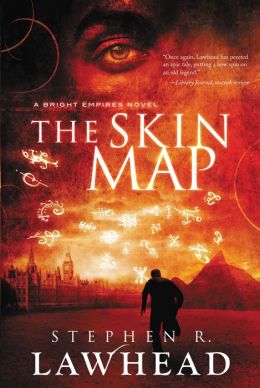
The Skin Map, by Stephen R. Lawhead. Unabridged audio.
 Stephen R. Lawhead is one of my favorite fantasy authors,
but he has dipped into science fiction before, which is the genre where this
series (this is the first book of Bright Empires) belongs.
Stephen R. Lawhead is one of my favorite fantasy authors,
but he has dipped into science fiction before, which is the genre where this
series (this is the first book of Bright Empires) belongs.
Kit Livingstone is an ordinary fellow, with an ordinary
life, an ordinary job, and an ordinary girlfriend. Until he is visited by his
long-lost great-grandfather Cosimo. His long-dead great-grandfather Cosimo.
With Cosimo's help, Kit finds that he can travel along ancient ley-lines to
other times and/or other dimensions, and is recruited to the search for the one
complete map of the lines. This is a parchment made from the skin of a man who
learned about the ley-lines, and then tattooed them onto his body. It turns out
that Cosimo and Kit are not alone in this quest to the find the skin map, and
then the race is on.
The Skin Map, by Stephen R. Lawhead. Unabridged audio.
 Stephen R. Lawhead is one of my favorite fantasy authors,
but he has dipped into science fiction before, which is the genre where this
series (this is the first book of Bright Empires) belongs.
Stephen R. Lawhead is one of my favorite fantasy authors,
but he has dipped into science fiction before, which is the genre where this
series (this is the first book of Bright Empires) belongs.
In the past, Kit in joined in his quest by the enigmatic and
flirtatious Lady Fayth, while his girlfriend Wilhelmina struggles to survive on
her own in 17th century Prague, as the apprentice to a baker. All of these
characters get caught up in an omniverse
of intersecting realities as they chase down the secret of the skin map.
This is just the first in a series of books, so the story
does not come to a satisfying conclusion in terms of the overall plot, although
branches of the intersecting realities do merge towards the end to give the
story a nice launching-point into the next book.
Lawhead is strong in his characterizations, and the
relationships between Kit and his compatriots all seem realistic. There are
moments where credulity is strained between characters, especially in
Wilhelmina's story, but this is a typical issue with time-travel stories -- I
just don't think that people would be so blasé about meeting others from
hundreds of years in the future. But again, that is a constant worry in this
type of tale, and Lawhead does the best he can with that issue. The action is
strong, the plot is intriguing, and the dangers that our crew of heroes face in
future stories will bring me back to book #2 in the series.
source: public library
Friday, May 23, 2014
Justin Holcomb on Heresy
From a conversation between Hoclomb and author Rachel Held Evans, on her blog:
"Heresy is not located in one’s beliefs about baptism, the continuation of certain spiritual gifts, women in ministry, or political issues. It is a specific and direct denial of any of the central beliefs of the Christian church about the deity and identity of the triune God and about the person and work of Jesus Christ."
"Heresy is not located in one’s beliefs about baptism, the continuation of certain spiritual gifts, women in ministry, or political issues. It is a specific and direct denial of any of the central beliefs of the Christian church about the deity and identity of the triune God and about the person and work of Jesus Christ."
Friday, April 25, 2014
John Paul II on Shepherds
"Christan tradition has adopted the biblical image of the shepherd in three forms: as the one who carries the lost sheep on his shoulders, and the one who leads his flocks to green pastures, and as the one who gathers his sheep with his staff and protects them from danger. In all three images there is a recurring theme: The shepherd is for the sheep, not the sheep for the shepherd."
Subscribe to:
Posts (Atom)